Oreo Mousse Cake
Introduction
There are recipes that arrive fully formed — a family secret, a pastry chef’s signature — and then there are those that arrive as a conversation between place and product. The Oreo Mousse Cake belongs to the latter category: a transatlantic dialogue that marries an industrial-age cookie with the European art of light, airy mousse. I remember first encountering it in a seaside café in Lisbon, where a woman at the next table insisted I try a slice she described with reverence. Her eyes lit when she spoke of the cream, the crumb, the memory wrapped up in each forkful. It tasted of childhood afternoons and cosmopolitan evenings, an edible bridge between the comfort of familiar brands and the refinement of chilled, whipped textures.
As a traveler and a teller of food stories, I trace dishes like this across cities and crowds. The Oreo Mousse Cake is at once a souvenir and a canvas — it registers the taste of globalization and the quiet, ongoing domestic rituals of dessert-making. Its presence in kitchens across continents is not merely about convenience; it is about how people repurpose what they have into moments of care, celebration, and memory. Here, in this piece, I will wander through its origin and adaptations, tell you how to make it without altering the familiar formula, and offer the cultural textures that surround this deceptively simple dessert.
The origin story & regional influence behind this dish
You could trace the Oreo Mousse Cake to two distinct streams of culinary history. The first is the Oreo cookie itself, born in 1912 in an industrial bakery in New Jersey and quickly becoming a global emblem of American packaged sweets. The second is mousse — a technique from French culinary practice that prized air as an ingredient, a textural philosophy developed and refined across European patisseries.
When these two currents met, they produced something hybrid and joyful. The cookie, with its cocoa-laced crunch and sweet filling, offers a ready-made chocolatey base. The mousse, airy and cool, offers a counterpoint: silk against crumb, lightness against density. In places like the United States, the mashup feels entirely natural, almost inevitable — a homebaker’s answer to the glossy, plated desserts of restaurants. In the Philippines, Oreo-based desserts became integrated into festive tables, where the cookie’s bold, familiar flavor works well alongside tropical fruits. In parts of Latin America, similar desserts lean into heavy cream and condensed milk, adapting the mousse to local tastes and the region’s love of creamy textures.
Cultural influence here is less about provenance and more about adoption. The cake becomes a site of exchange: an American product folded into French technique and reimagined by cooks from Mumbai to Madrid. Each locale brings its own sensibility: an extra flourish of chopped pistachios in Beirut, a citrus note in coastal Spain, a generous ring of whipped rosettes in a Brooklyn bake sale. The recipe, while simple, is porous enough to absorb history.
How to make Oreo Mousse Cake
Ingredients :
1 package Oreo cookies, 1/2 cup unsalted butter, melted, 2 cups heavy whipping cream, 1 cup powdered sugar, 1 teaspoon vanilla extract, 8 oz cream cheese, softened, 1 cup Oreo cookie crumbs, Whole Oreos for decoration
Directions :
- Crush the Oreo cookies and mix with melted butter to form a crust. Press into the bottom of a springform pan.
- In a large bowl, beat the cream cheese until smooth. Add powdered sugar and vanilla extract, and mix until well combined.
- In a separate bowl, whip the heavy cream until soft peaks form. Gently fold the whipped cream into the cream cheese mixture until combined. Stir in the Oreo cookie crumbs.
- Pour the mousse over the crust and spread evenly. Refrigerate for at least 4 hours or until set.
- Decorate with whole Oreos before serving.
These are the instructions as they travel from kitchen to kitchen — a minimal script that yields something generous. It takes on the flavor of whoever prepares it: the baker who presses the crumbs by hand, the child who counts whole Oreos as decoration, the party host who slices carefully for guests. The recipe is a common language with regional accents.
Ingredients through a cultural & historical lens
List the components and you see the map of modern food: packaged cookies, dairy fats, a hint of vanilla. Each ingredient carries stories. The Oreo begins as a product of early 20th-century industrialization — designed to be shelf-stable, mass-produced, and instantly familiar. Its role in this cake is emblematic of the way global brands have seeped into home cooking, becoming raw materials for creative adaptation.
Butter and cream have long histories of status and technique. In Europe, cream is the marker of patisserie, an ingredient of luxury when churned into mousses and custards. In many tropical countries, the same role is often played by condensed or evaporated milk, but the heavy whipping cream used here signals a particular texture: light, chilling, and airy. Cream cheese, relatively modern in its ubiquity, provides tang and body — a nod to the cheesecakes that have their own lineage in American and European kitchens.
Powdered sugar and vanilla are the quiet enhancers, less a story of industry and more of taste cultivation — the gentle sweetness and warm aromatics that transform texture into memory. The whole Oreos used for decoration are an invitation: a visual promise that anchors the dessert to its cookie progenitor. Together, these ingredients show how convenience and craft can coexist; industrial products become the raw materials of intimate, domestic rituals.
Cooking the dish: sensory notes & traditional techniques
Making an Oreo Mousse Cake is a sensory pilgrimage. The first tactile pleasure comes when you crush the cookies — the satisfying shudder of cocoa and sugar giving way to fine crumbs. The aroma at this stage is unexpectedly comforting: chocolate and childhood, a smell that travels memory lanes faster than any guidebook. Mixing crumbs with warm, melted butter produces a granular, compacting earthiness; pressing that into a pan, you feel the crust taking shape beneath your palms.
The cream and cream cheese stage invites patience. The whipped cream transforms before your eyes into clouds: glossy, soft peaks forming like weather in a bowl. Folding it into the cream cheese mixture is a gentle choreography that resists force. The mousse should remain airy; overworking removes the very breath that makes it mousse. That care — the hush in the kitchen, the slow, respectful folding — is part of the ritual. Refrigeration completes the alchemy: the mousse settles into a cool, yielding set, and the crust firms, creating a chorus of textures.
Traditional techniques here are more about feeling than about exact temperatures. In older European kitchens they would say: whip until the cream sings; in lively family homes, it is judged by touch and sight. A springform pan is often used because it allows the cake to be revealed, unclasped like a small stage curtain, a moment that always invites applause.
How different regions prepare their version
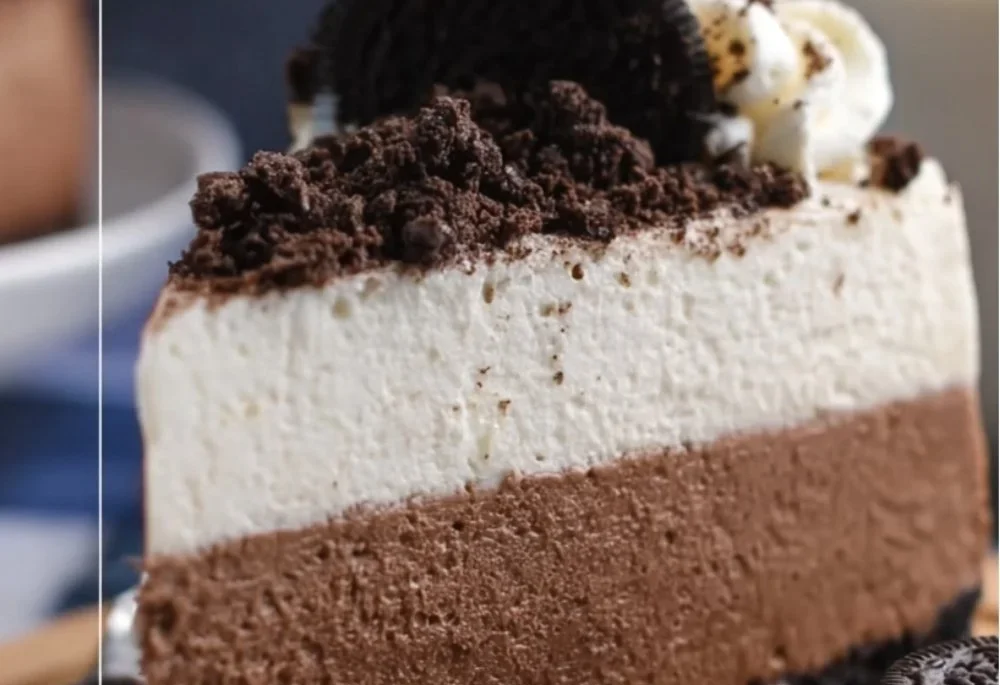
The global life of this cake is instructive. In the United States, it often appears in its pure form: a dark Oreo crust, pale whipped mousse speckled with crumbs, and whole cookies as decoration. Bakers here honor the contrast between the dense base and the airy top.
In the Philippines and across Southeast Asia, creaminess is celebrated; variations may introduce layers — sometimes condensed milk folded in for extra richness, occasionally a ring of tropical fruit at the edge. In Latin America, cooks sometimes add a touch of coffee or cinnamon to the crust, nodding to local affinity for spiced sweets. In the Middle East, a sprinkle of crushed pistachios or a dusting of rose petals can transform the cake into something that aligns with local flavor palettes without losing its identity.
Even within cities, versions diverge: a Brooklyn bakery might top it with salted caramel and a deconstructed presentation, while an Italian home cook might serve smaller, individual portions in glasses, echoing tiramisu’s intimacy. The recipe is adaptable, and that adaptability is a kind of cultural conversation.
Traditional ways this dish is shared or served
Serving this cake is an act of communal generosity. In many homes it appears on birthdays, not as the central sponge-layered spectacle, but as a comfort: easy to make, quick to please, and visually pleasing. It is the dessert for impromptu gatherings — a last-minute indulgence when friends drop by, for which the host can whip up sweetness without an oven.
In formal settings, a chilled slice can finish a multi-course meal with a lightness the dinner needs. At coffee shops, it is served alongside steaming espresso, the chilly mousse offering a gentle counterpoint to hot bitterness. In family contexts, it becomes a ritual: the way the cake is sliced, which corner piece someone claims, the child who earns the privilege of placing whole Oreos on top — these small acts encode affection and memory.
The cake is also a vehicle for nostalgia. People often bring versions of it to potlucks or school events, where the familiar Oreo motif turns strangers into conspirators, linked by shared brand recognition and the universal joy of cream and cookie.
Storing the dish without losing its cultural essence
Storage is practical but also cultural. Refrigeration is essential: the mousse wants cool air and the crust wants to stay firm. Yet how one stores the cake can be a cultural statement. In some households, a cake is covered with a cloth and kept on a cool counter for a few hours, signaling confidence in the kitchen and a rhythm of life that trusts the environment. In other homes, single-serving pieces are wrapped in parchment and placed in a communal refrigerator compartment, each piece a promise for a later quiet moment.
Freezing is possible but controversial. Some argue that freezing dulls the mousse’s airy texture; others, particularly in places where stovetop refrigeration isn’t reliable, freeze slices to preserve them between festival days. The essence of the cake — its identity as an inviting, immediate dessert — is best preserved by chilling rather than burying it. When stored, a gentle reminder: return the cake to a cool place before serving to let the mousse regain its softness; this small ritual reconnects you to the cake’s intended mouthfeel.
Cultural questions people often ask
Is it a cheesecake or a mousse? The answer depends on where you stand and what you grew up with. In many places it reads as a light cheesecake; elsewhere it is a mousse cake. People ask whether the Oreo gives it enough chocolate flavor; some answer by adding more crumbs to the filling, while others see the cookies as a counterpoint to the cream.
Others ask about authenticity: is it authentic to modify the recipe with local ingredients? Absolutely. Authenticity in food is often less about replication and more about lived practice — how a dish becomes meaningful in a setting. Home cooks may ask how to make it vegan or eggless, a modern concern that shows the recipe’s capacity to evolve.
Finally, people wonder whether such a simple cake can hold ritual significance. The answer I’ve found across kitchens is yes: the simplest dishes often accumulate the most stories because they are the easiest to rehearse, hand down, and share.
A closing note on food, memory & travel
Travel teaches you that dishes are not static objects but living conversations between the past and present, self and other. The Oreo Mousse Cake is emblematic of this: a hybrid dessert that carries both global commerce and intimate kindness. Wherever I’ve tasted it — in a bustling Mumbai apartment, a quiet Lisbon café, or a sunlit backyard in Buenos Aires — what stays with me is not only the texture or the sweetness but the smallness of the act that produces it: pressing crumbs into a pan, folding air into cream, setting the whole thing to chill while conversation continues.
That suspended time in the refrigerator is itself a cultural ritual: a pause in which the cake becomes more than ingredients. It is the moment when expectation gathers and memories are suggested. Sharing a slice becomes an exchange, and in that exchange the cake accrues new stories. For those who love to travel with their plates and their memories, this dessert is a portable touchstone — a reminder that food can be both familiar and surprising, a single cookie and a whole world.
Conclusion
For readers who want to explore variations or follow a step-by-step guide online, I recommend these resources: Oreo Mousse Cake Recipe: How to Make It, which offers a classic approach; Oreo Mousse Cake – Inside BruCrew Life, with ideas for presentation and serving; and Easy Chocolate Mousse Cake with Oreo Crust | Plated Cravings, which provides another take on combining mousse and cookie crust. Each link opens a window onto how this simple, beloved dessert continues to be reshaped wherever it’s made.
Oreo Mousse Cake
Ingredients
Method
- Crush the Oreo cookies and mix with melted butter to form a crust. Press into the bottom of a springform pan.
- In a large bowl, beat the cream cheese until smooth. Add powdered sugar and vanilla extract, and mix until well combined.
- In a separate bowl, whip the heavy cream until soft peaks form. Gently fold the whipped cream into the cream cheese mixture until combined. Stir in the Oreo cookie crumbs.
- Pour the mousse over the crust and spread evenly. Refrigerate for at least 4 hours or until set.
- Decorate with whole Oreos before serving.