3-Ingredient Banana Donut Holes
Introduction
There are certain recipes that read like postcards from a life lived in brief, delicious pauses: a quiet morning in a city that wakes late, a child’s laughter in a courtyard, the smell of bananas ripening on a kitchen counter. As someone who has wandered through markets from Lisbon’s tiled alleys to the open-air stands of Accra, I have learned to listen for the small recipes that belong to no one place and yet belong everywhere. The 3-Ingredient Banana Donut Holes are one such whisper — a humble, intimate morsel that carries the warmth of home kitchens and the improvisational spirit of people who cook with what they have. They are not ornate; they do not announce themselves. Instead they arrive as soft, golden bites that taste like the quiet of late afternoons and the gentle insistence of memory.
In Sofia — the city I have come to call a second home — these donut holes feel particularly apt. Here, where the Balkans fold into Roman and Ottoman memories, simple dough and fruit have always met in kitchens and markets. A banana, beaten into softness and married to flour and a touch of lift, becomes an emblem of how food travels: imported fruit, local flour, a hands-on approach to sweetness. In a house that forgets about time between cups of coffee and stories, three ingredients can be enough for an evening’s hospitality. This introduction is a small invitation: to follow the recipe not as a set of instructions alone, but as an entry point into a world where frugality is a kind of generosity, and where the plain becomes strangely sublime.
The origin story & regional influence behind this dish
The precise birthplace of 3-ingredient banana donut holes is as difficult to pin down as the origin of many simple snacks. What is certain is that this recipe lives in the vast global conversation about bananas and fried or baked dough — an exchange that spans West African fritters, Caribbean banana breads, South Asian sweet fritters, and European fried dough. Bananas themselves are transcontinental travelers: native to Southeast Asia, propagated through colonial trade routes, and naturalized into the diets of the Americas, Africa, and Europe. Wherever bananas took root, cooks found ways to celebrate their softness and sugar, often combining them with the most accessible storecupboard items.
In regions where yeast or eggs were scarce or too costly, baking powder and flour offered quick chemistry — the kind that turns mashed fruit and pantry staples into a comforting fried or baked treat. The donut hole, a compact cousin of the bigger ring-shaped pastry, has an everyplace quality: it can be a breakfast solace, a teatime companion, or a child’s hand-held prize. In the Southern United States and the Caribbean, banana fritters appear with spices and rum; in parts of Latin America, mashed banana sweetcakes are a cheap, beloved snack; in Eastern Europe, small fried dough bites have served as improvised comforts during austere winters. The 3-ingredient version strips these tendencies to their essence, allowing the banana’s perfume to steer the whole experience.
How to make 3-Ingredient Banana Donut Holes
To make these donut holes is to practice a kind of culinary economy that favors feeling over fuss. Begin by warming your hands with the soft rub of ripe bananas, let the smell lift the air in your kitchen. Mix simply, shape gently, and let the oven do the patient work of turning tender lumps into golden orbs. Each step carries an intimacy: mashing is a tactile meditation; shaping invites slight imperfection; baking rewards patience with a scent that fills the room like a remembered home.
Ingredients :
2 ripe bananas, 1 cup flour, 1 tablespoon baking powder
Directions :
- Preheat the oven to 350°F (175°C)., 2. In a bowl, mash the ripe bananas until smooth., 3. Add the flour and baking powder, mixing until combined., 4. Shape the mixture into small donut hole shapes and place them on a baking tray., 5. Bake for about 15-20 minutes or until golden brown., 6. Let cool and enjoy!
Ingredients through a cultural & historical lens
Those three ingredients tell a story about trade, scarcity, and creativity. Bananas represent colonial and post-colonial commerce, fruits that moved across oceans and reshaped diets. Flour — plain, white, wholegrain or otherwise — embodies agrarian histories: milling traditions, local grains, and the texture preferences of different regions. Baking powder is the modern touch: a 19th-century innovation that democratized leavening, allowing cooks without time or leavened cultures to create lift and lightness swiftly.
When I think about these elements, I imagine people in wartime ration kitchens and street vendors who had to make do; I imagine grandparents showing grandchildren how a ripe banana can be more than a snack. In many places, the simplest recipes matter most because they are flexible and resilient. A banana’s sweetness transforms flour into cake-like bites without the need for eggs, butter, or sugar. This economy of flavor has political and cultural implications: it is the language of neighborhoods where resourcefulness is celebrated and where food becomes ritual, memory, and solace.
Cooking the dish: sensory notes & traditional techniques
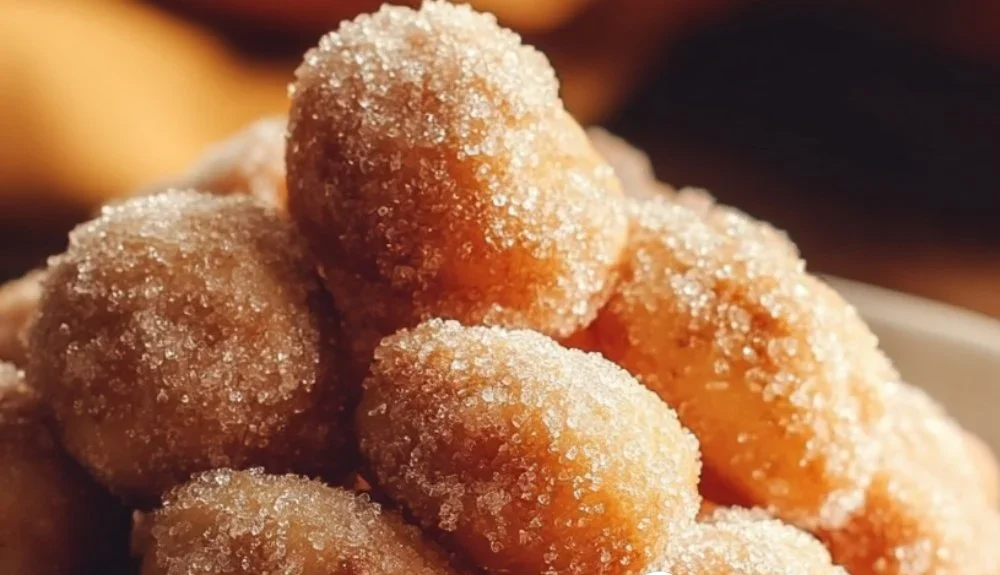
The first sensory note is the smell: as the tray warms, the kitchen fills with a gentle, almost floral banana perfume, mingled with warm grain and the faint toastiness of baked dough. The exterior of each donut hole should blush golden, while the inside remains tender and slightly moist, a texture that nods to banana bread but with a bite-sized intimacy. There is a soft resilience to the crumb — not airy like a yeasted dough, but pillowy in a comforting way — and the natural sugars of the banana create caramelized notes at the edges.
Traditional techniques that resonate here are minimal but meaningful. In many cultures, the act of mashing the fruit is communal: a grandmother’s skilled fingers take the lead, showing you when the texture is right. Shaping is similarly generous; hands shape each orb not to perfect symmetry but to friendliness. Baking, rather than frying, gives the recipe a quiet restraint that feels homey and practical. In humid climates, cooks might prefer to briefly pan-fry the holes for a crisper exterior, while in places with ovens, the gentle bake yields a uniform color and a cleaner finish.
How different regions prepare their version
If you walk from a Caribbean beach toward an inland market, you will see variations spring from the same idea. In Jamaica and Trinidad, banana fritters are often spiced with nutmeg or cinnamon and fried to a golden crackle, sometimes sweetened with a syrupy glaze. In parts of West Africa, plantain and banana fritters appear with palm oil and a hint of chili for savory contrast. Southeast Asia offers banana fritters in coconut batter, fried crisp and eaten with a squeeze of lime. In Europe, especially in times of scarcity, mashed fruit folded into flour and baked in small shapes served as a makeshift tea cake.
The 3-ingredient baked donut hole is perhaps most at home where simplicity is prized. In urban apartments in Eastern Europe, a tray of these might arrive at a neighbor’s door with a comforting knock; in American college housing, a novice cook might whip them up between exams. Each region interprets the idea according to resources and taste, adding spices, sugars, or cooking fat, but the core remains gloriously simple — a reminder that many food traditions converge on the same human needs.
Traditional ways this dish is shared or served
These donut holes are intimate food. They are handed around at children’s parties, tucked into lunchboxes, or set beside a cup of strong coffee in the early morning. In many homes, they are the sort of thing that arrives when someone knocks at the door and a voice calls, “Come in, we’ll have tea.” They travel well for picnics and are forgiving of brief excursions in a basket. Because they require no icing or elaborate presentation, they are often served on a simple plate, dusted with a little sugar or left plain — each version a small act of hospitality.
There is also a ritual in making them together. Kneading and shaping give room for conversation; elders pass down tips, and children learn how to judge ripeness by smell and texture. The act of sharing these small cakes is, in many places, a way of teaching generosity: you break one in half for a friend, you save a few for later, you reheat one and pair it with yogurt or a spoon of jam. The recipe’s modesty makes it versatile in ceremonies both quiet and bright.
Storing the dish without losing its cultural essence
Storage is a matter of respect and rhythm. Because these donut holes are moist, they keep best in an airtight container at room temperature for one to two days; beyond that, they may be tucked into the refrigerator for up to four days, though refrigeration can dull their soft texture. A gentle reheat — a few minutes in a warm oven or toaster oven — revives the aroma and softens the crumb, bringing back the sense of a just-baked moment.
The cultural essence is preserved not merely by technique but by intention. Keeping a small stash for a neighbor, wrapping them in paper, or leaving them on a counter with a note sustains the social life of the recipe. Even if stored in modern containers, the stories around the food — who baked it, why, and for whom — are the true preservers of tradition.
Cultural questions people often ask
People often wonder whether this is “authentic” to any single tradition. The honest answer is that authenticity is a braided thing: this recipe is authentic to the impulse to make sweetness with what you have. Others ask whether the lack of eggs or sugar makes it less satisfying. On the contrary, the banana provides natural sweetness and moisture; the absence of other ingredients foregrounds the fruit’s perfume. Another common question: can the recipe be made in other ways? Yes — every culture that embraces these flavors will add its own flourish — but the heart of the dish is its simplicity.
Lastly, there is curiosity about when to make them: are they for breakfast, for dessert, for late-night consolation? The beauty of these donut holes is their timeliness; they belong to the in-between hours, to the open moments when you want to offer something small and sincere.
A closing note on food, memory & travel
Travel teaches that the most meaningful recipes are often those that summon people rather than places. The 3-Ingredient Banana Donut Holes are a lesson in that philosophy: little orbs of memory that can be formed at any kitchen table in the world, carrying with them the aroma of far-off markets and the tactile warmth of hands at work. To make them is to honor the legacy of resourceful cooking, to taste the convergence of histories that brought bananas and flour together, and to recognize that comfort often arrives in the plainest guise.
Wherever you are, try making a batch and offer them to someone who needs the small balm that food gives. Watch how a simple tray can soften a conversation, recall a childhood, or seal a new friendship. These bites are more than sustenance; they are a compact tradition, a portable memory, and a humble bridge between cultures. May every warm, banana-scented mouthful remind you of the world’s generous, shared table.
Conclusion
For a straightforward demonstration of this idea in practice, you can compare versions and method notes on a well-documented page about similar recipes: 3 Ingredient Banana Donuts recipe.
3-Ingredient Banana Donut Holes
Ingredients
Method
- Preheat the oven to 350°F (175°C).
- In a bowl, mash the ripe bananas until smooth.
- Add the flour and baking powder, mixing until combined.
- Shape the mixture into small donut hole shapes and place them on a baking tray.
- Bake for about 15-20 minutes or until golden brown.
- Let cool and enjoy!