Lemon Chicken Orzo
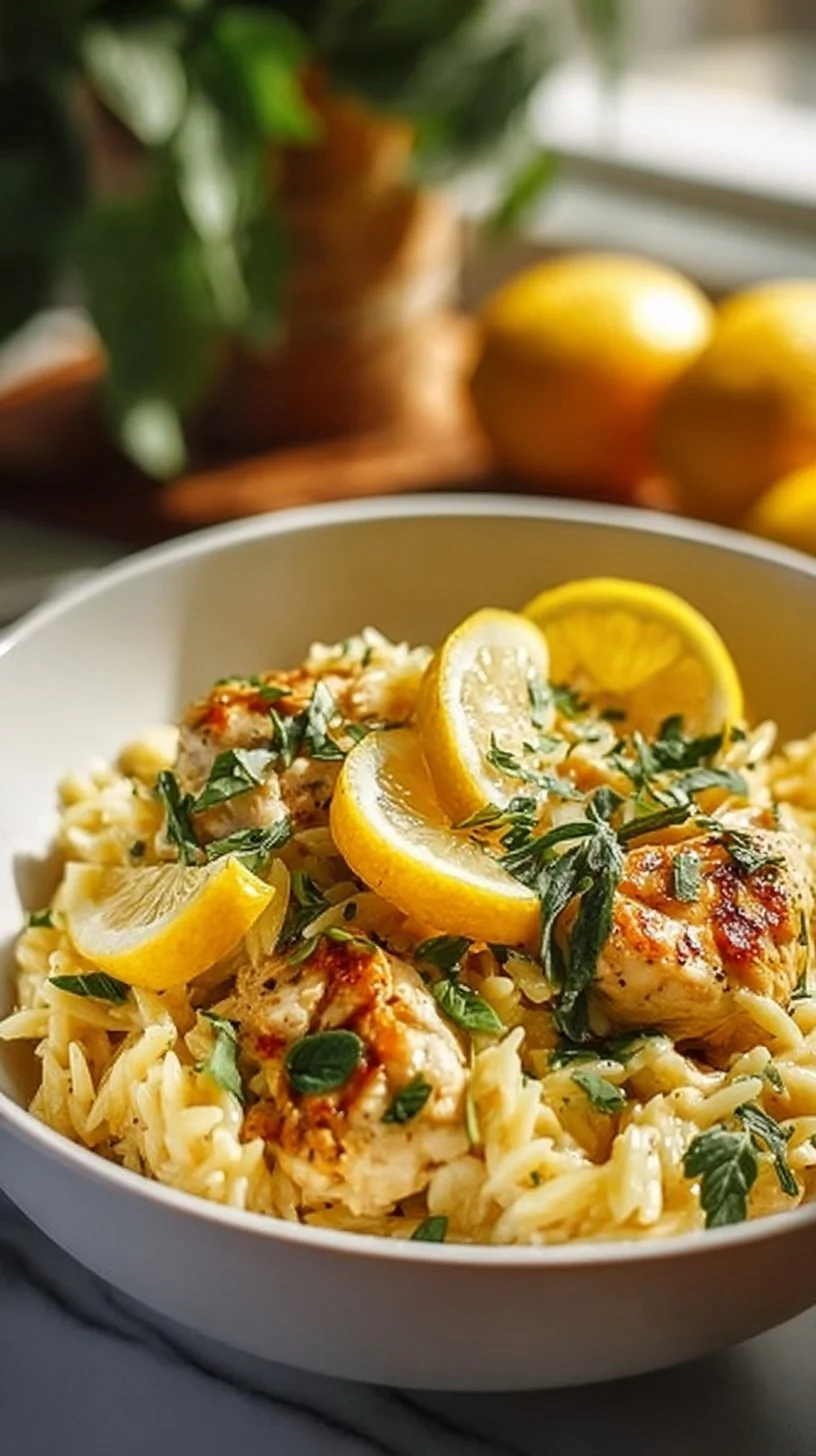
There are meals that arrive like light—you taste them and a window opens to place, weather, and the particular hum of a household. Lemon Chicken Orzo is one of those dishes: a simple constellation of bright citrus, warm broth, tiny rice-shaped pasta, and tender chicken that feels like a sunlit afternoon by the sea. I first met a version of this dish in a small seaside taverna where the proprietor, a woman with flour-dusted hands and a laugh like bells, served it in a shallow bowl with crusty bread and a pitcher of cool water. The steam rose, fragrant with lemon and garlic, and the room felt forgiving. That sensation — comfort braided with brightness — is what keeps this recipe alive in kitchens from Athens to suburban backyards.
Culinary travel has taught me that recipes are less about strict lists and more about the stories they carry. In one suitcase I packed spices and a notebook; in another, the memory of a grandmother stirring orzo in a wide pan while narrating the village’s weddings. If you are drawn to cross-cultural comfort foods, you might also appreciate a hearty family classic like baked chicken cordon bleu, where the interplay of cheese, breading, and roast chicken sings a different, yet similarly domestic, hymn.
The origin story & regional influence behind this dish
Lemon and chicken is a pairing that travels easily across the Mediterranean and beyond. The marriage of bright citrus and poultry is found in Greek kitchens in the form of kotopoulo lemonato, in Turkish households as limonlu tavuk, and in Italian coastal recipes where lemon oil and coastal herbs tint otherwise simple preparations. Orzo itself—small, almond-shaped, pasta—speaks of Italy, yet its technique of cooking in broth until porridge-like is shared throughout southern Europe and the Near East. This confluence of elements tells a story of trade routes and seasonal lives: lemons picked from groves by the sea, wheat ground into tiny pasta, chickens raised in gardens where children chased them beneath fig trees.
Orzo’s name derives from the Italian for barley—an echo of centuries when wheat and grain were shaped into small, versatile forms to stretch a meal across a family. When lemon entered the kitchens of the Mediterranean, it did more than flavor; it preserved, brightened, and signaled luxury in winter months. The dish as we see it now—chicken, orzo, lemon, garlic, oregano—reads like a map, a composite of the Greek islands’ citrus groves, the Italian love of small pastas, and the Ottoman kitchens where spices moved like whispering merchants. Each region laid a hand on the recipe, and the result is a comfort food that can be at once humble and elegant.
How to make Lemon Chicken Orzo
Making Lemon Chicken Orzo is less about technique and more about attention: to timing, to balance, to that moment when steam lifts and the kitchen fills with citrus. The recipe is compact and honest. The chicken is cut into bite-sized pieces so each mouthful carries protein, the orzo softens to a tender chew, and the lemon—zest and juice—cuts through the richness, leaving a clear, bright finish that lingers like a remembered conversation.
When I cook this in a rented apartment in a city I’ve never lived in, I think about how the recipe translates: a single skillet, an aroma that announces dinner to anyone passing the door. It is the sort of dish that invites neighbors to knock and stay. The directions are straightforward, but the ritual—rubbing hands with lemon zest, the first sizzle of chicken entering hot oil, the hush that falls as broth is poured—makes it feel ceremonial. Below are the exact ingredients and steps as given, preserved in their original simplicity.
Ingredients :
4 boneless, skinless chicken breasts (about 1 lb), 1 cup orzo pasta, 4 cups low-sodium chicken broth, 2 fresh lemons (zest and juice), 3 cloves garlic (minced), 1 tsp dried oregano, 2 tbsp olive oil, Salt and pepper to taste
Directions :
Dice the chicken into bite-sized pieces., Heat olive oil in a large skillet over medium heat. Add chicken, season with salt and pepper, and cook until golden brown (6-7 minutes)., Stir in minced garlic and oregano; cook for about 1 minute until fragrant., Add orzo to the skillet, stirring to coat it in the juices., Pour in chicken broth and lemon juice. Bring to a simmer; cover and cook for 10-12 minutes until orzo is tender., Remove from heat, stir in lemon zest, and serve warm.
Ingredients through a cultural & historical lens
Consider each ingredient as if it were a traveler: the chicken, humble and universal, has been raised in courtyards and on tiny terraces, an animal of economy and ceremony. A boiled chicken has fed mourning families and christening guests; a roasted bird has marked summer banquets. Orzo, though just pasta, carries millennia of grain history—tiny, portable, and capable of adopting local flavors. In coastal kitchens it absorbs sea-scented broths; in mountain homes it swells into a warming, almost porridge-like dish.
Lemon is the lyric. Introduced to the Mediterranean centuries ago, it reshaped cuisines: it preserved, brightened, and became the shorthand for freshness. Garlic is the song of home cooking—ubiquitous, sharp, and steady. Oregano nods to sun-baked hillsides; dried because it evokes summers preserved in jars. Olive oil is the liquid memory of a grove: green, peppery, and sustaining. Even salt, the plainest ingredient, ties this dish to ancient trade and the human need to season life.
Viewed together, these ingredients are not accidental. They reflect climates where citrus thrives, where wheat becomes small pastas, and where broth is the evening’s common ground. The combination suggests a table where people eat with their hands for bread and with spoons for the orzo, where conversation and pausing—between sips and bites—matter.
Cooking the dish: sensory notes & traditional techniques
The first note is aroma: olive oil warmed in the pan releases a grassy scent that becomes peppery when the chicken hits the heat. As the garlic joins, the kitchen begins to hum; there is an almost floral sharpness as lemon juice crashes into hot broth, and the steam carries it to the nose like a promise. Orzo, when cooking, swells and softens, releasing starch that gently thickens the broth into a comforting cradle for the chicken pieces.
Texture matters here. The chicken should offer a tender bite that resists slightly; orzo — when perfectly cooked in this method — is neither chalky nor mushy but plump, its surface slick with the olive oil and lemon-scented broth. The lemon zest at the end is crucial: it perfumes the dish with volatile oils that dissipate quickly, so the final stir is almost a benediction. Traditional cooks often stress the small moments—the resting of the pan off heat, the stirring of zest through the warmed orzo—because those gestures are where flavor and memory merge.
In homes where this dish is a family staple, the pan might be left on the table for everyone to serve themselves, ladles clinking, laughter filling spaces between forkfuls. The technique is simple, but its cultural resonance comes from how and with whom it is shared.
How different regions prepare their version
Across the Mediterranean, Lemon Chicken Orzo wears many skins. In Greece, you might find it enriched with a scoop of avgolemono—an egg-lemon emulsion whisked into the broth to create a silky, custardy texture that turns the orzo into something akin to a savory pudding. In coastal Italy, cooks might swap oregano for a sprig of rosemary and finish with a drizzle of robust olive oil and a shower of Parmigiano to echo northern tastes. In Turkey, the dish could be brightened with a scattering of sumac or a handful of fresh parsley to lend a tart, herbaceous edge.
In American kitchens, this dish often arrives as a weeknight favorite—streamlined, bright, and anchored in family routines. There, lemon may be generous, and the orzo is sometimes browned slightly before liquid is added, producing a nuttier profile. Across these versions, the soul remains: citrus cutting through a warm, brothy starch anchoring tender chicken. For a different but equally communal chicken recipe, I’ve written about sharing bold, saucy bites on flatbreads like BBQ chicken flatbread, where the conversation around a meal becomes part of its flavor.
Traditional ways this dish is shared or served
Lemon Chicken Orzo is at home on many tables. In village celebrations it might be ladled into large bowls and placed in the center so everyone eats family-style, fingers wiping the rim of a dish and children scraping the last pearls of orzo for themselves. In city apartments, it becomes a gentle Sunday dinner, served with a simple salad and a loaf of bread to soak up the last drops of broth. Its portability makes it a common offering at potlucks and picnics; glass containers arrive with a sheen of olive oil on top—a promise of reheated warmth.
The dish also travels into seasons: bright lemon in spring and summer, comfortingly warm in colder months when broth feels like a small act of care. It is one of those recipes that grandmothers pass down not as rigid instructions but as habits—“add more lemon if it tastes sleepy”—and so it becomes a living thing, reshaped by each set of hands.
Storing the dish without losing its cultural essence
When preserving Lemon Chicken Orzo, the aim is to retain its brightness. Refrigerate in shallow containers so the orzo cools quickly; when reheating, use a low flame and a splash of water or broth to coax the orzo back to a supple texture. Add a touch of fresh lemon or a scatter of fresh herbs at the moment of serving—this small act revives the original lift of the dish.
Culturally, storage is also about memory: containers that once held a neighbor’s weekday dinner are reused, lids bear the fingerprints of multiple kitchens, and the scent of lemon on the lid can bring an entire evening back. Avoid overcooking on the second day; the pleasure of the dish is as much in the tender resistance of the orzo as it is in the citrus clarity.
Cultural questions people often ask
Why lemon? Lemon has been used historically as a way to brighten and balance flavors, to preserve, and to signal a season or status. People ask if orzo is rice—it’s pasta, shaped to resemble rice, a testament to the adaptability of grains and the ingenuity of cooks. Others wonder whether chicken must be diced—bite-sized pieces ensure even cooking and that every mouthful contains both protein and pasta, a pragmatic choice in communal eating.
There are questions about authenticity—“Is this Greek? Italian? Turkish?”—and the answer often surprises: it is all of those and none. The recipe’s adaptability is its identity. People also ask about substitutions; while variations are welcome, the spirit of the dish lies in the interplay of warm broth, lemon, and small pasta. Change too much and you create a new memory; that’s not a failure, but a different story.
A closing note on food, memory & travel
Food is map and memoir. Lemon Chicken Orzo is a dish whose simplicity invites conversation about where we come from and how we feed one another. It asks little of us and returns much: a fragrant bowl that can conjure a seaside taverna, a winter kitchen, a grandmother’s hands. In my travels, the best meals have been those that are easy to prepare and hard to forget—where the recipe is less a list of instructions and more a compass pointing toward connection. When you make this dish, consider who you will invite to the table; the flavors will do their work, but the memory will be made by company and the stories you tell between spoonfuls.
Conclusion
If you’d like to explore another home-style take on Lemon Chicken Orzo, this adaptation offers a comforting one-pot approach at Lemon Chicken Orzo – Cooking For My Soul, which captures a cozy family vibe. For a bright, herb-forward version that leans into summer flavors, see the thoughtful variations at Lemon Chicken Orzo – Salt & Lavender. For a richer, buttery reinterpretation that emphasizes a velvety sauce, consider the recipe at One Skillet Lemon Butter Chicken and Orzo. – Half Baked Harvest. And for a streamlined one-pot comfort preparation that’s easy to return to on busy nights, this version is a reliable reference: Lemon Chicken Orzo (One Pot!) – The Cozy Cook.
Lemon Chicken Orzo
Ingredients
Method
- Dice the chicken into bite-sized pieces.
- Heat olive oil in a large skillet over medium heat.
- Add chicken, season with salt and pepper, and cook until golden brown (6-7 minutes).
- Stir in minced garlic and oregano; cook for about 1 minute until fragrant.
- Add orzo to the skillet, stirring to coat it in the juices.
- Pour in chicken broth and lemon juice. Bring to a simmer; cover and cook for 10-12 minutes until orzo is tender.
- Remove from heat, stir in lemon zest, and serve warm.