Heaven on Earth Cake
Introduction
This recipe, Heaven on Earth Cake, is a composed trifle that relies on a deliberate interplay of structure, moisture barriers, and textural contrast. The goal is not merely to assemble components but to manage how each element releases and absorbs moisture over time so the final spoonful retains distinct layers—airy cake, syrupy fruit, creamy custard, and light whipped cream—without collapsing into uniform mush. For a technical comparison of how delicate cakes hold up under layered constructions, consult a note on sponge resilience such as chewy maple cinnamon cookies, which highlights crumb integrity under stress.
In this piece I will describe the culinary logic that governs this trifle, explain how each ingredient functions, and provide workflow and timing strategies to produce consistent results in both home and professional settings.
The culinary logic behind this dish
Heaven on Earth Cake is a textbook study in layered cuisine: a neutral, highly aerated base (angel food cake) provides lift and lightness; an acidic-sweet fruit component (cherry pie filling) brings brightness, color, and syrup; vanilla pudding contributes fat-stabilized creaminess and binding; and whipped cream supplies an ethereal finish and mouthfeel contrast. The sequence of components matters because of how they interact physically—syrup migrates downward, custard sets and reduces syneresis, and whipped cream serves as an insulating cap. Temperature, viscosity, and particle size determine how quickly flavors meld and textures change during chilling.
From a flavor-development perspective, the canned cherry filling supplies concentrated fruit sugars and pectin-like body; the pudding adds vanilla longness and sets the gel matrix; and the whipped cream softens the overall sweetness while contributing dairy fat for flavor transfer. Balancing these elements yields a dessert where each spoonful transitions from airy to syrupy to creamy, providing a layered tasting experience rather than a single homogeneous sweetness.
How to make Heaven on Earth Cake
Begin by assembling mise en place: have the angel food cake cubed, the cherry filling measured, pudding prepared as directed, and the heavy cream and flavorings chilled for whipping. Temperature and timing at assembly are as important as the steps you follow.
Ingredients :
1 angel food cake, 1 can cherry pie filling, 2 cups vanilla pudding, 1 cup heavy cream, 1 tablespoon sugar, 1 teaspoon vanilla extract
Directions :
- Cut the angel food cake into cubes and place half of the cubes in a trifle dish or large bowl.
- Spoon half of the cherry pie filling over the cake cubes.
- Prepare the vanilla pudding according to package instructions and pour half over the cherries.
- In a separate bowl, whip the heavy cream with sugar and vanilla extract until soft peaks form.
- Spread half of the whipped cream over the pudding.
- Repeat the layers with the remaining cake cubes, cherry pie filling, pudding, and whipped cream.
- Refrigerate for at least 2 hours before serving.
Do not alter the prescribed quantities or sequence; instead, focus on execution: cube the cake uniformly to ensure consistent absorption; spoon fruit so it remains localized; and chill the assembled trifle to complete pudding setting and allow moisture equilibration.
Ingredient analysis through a chef’s lens
Angel food cake functions as a neutral scaffold. Its low-fat, high-sugar, high-egg-white structure absorbs liquids but resists collapse when cut into moderate cubes because of its stable foam matrix. Uniform cube sizing (roughly 1–1.5 inch) is crucial to obtain even hydration and to maintain layer definition under a heavy fruit topping.
Cherry pie filling is a concentrated, syrupy component. The syrup will migrate, so spreading it in a controlled layer over cake cubes prevents downward migration into lower layers and over-saturating the base. The acidity and pectin-like body enhance perception of sweetness and provide a counterpoint to the pudding’s richness.
Vanilla pudding supplies both flavor and structure. Prepared pudding creates a gelatinized starch matrix that helps immobilize fruit juices and stabilize the whipped cream cap. Use the pudding exactly as instructed; undercooked pudding may be loose and promote syneresis, while overcooked pudding can become rubbery. The package directions calibrate starch gelatinization for a predictable texture.
Heavy cream, sugar and vanilla are standard for stabilized whipped cream. Achieve soft peaks only—this gives cream enough structure to hold on the pudding without becoming grainy or butter-like under refrigeration. Overwhipping will cause the cream to release fat and create a broken texture; underwhipping will allow collapse and seepage.
For a professional touch, keep all dairy and tools chilled to reduce heat transfer during whipping; this ensures faster, cleaner aeration and a silkier mouthfeel.
Kitchen workflow & technique breakdown
Workflow determines the final texture as much as ingredients do. Sequence your station: chill mixing bowls and beaters for the whipped cream first; cube the cake while the pudding is cooking to use downtime efficiently; and warm the trifle bowl slightly if it has condensation, wiping it dry to prevent unintended dilution.
Technique notes:
- Cubing: Use a serrated knife and a gentle back-and-forth motion to avoid compressing the angel food cake. Compressing the aerated crumb will accelerate syrup absorption.
- Spoon placement: Apply cherry filling with a slotted spoon to control syrup flow. Allow larger fruit pieces to rest on the cake rather than sinking into it.
- Pudding: Follow package timing exactly. Stir gently to avoid incorporating excess air, which can create undesirable foam and alter set quality.
- Whipping: Begin at medium speed to build body, then increase briefly to achieve soft peaks. Watch closely; soft peaks form rapidly for chilled cream.
- Layering: Spread layers with an offset spatula for even coverage. Ensure each layer is even in thickness for consistent serving quality.
Include a brief rest after assembly on the counter only if the kitchen is cool and you are ready to refrigerate promptly. Two hours is the minimum to allow the pudding to fully set and the flavors to harmonize.
One logistical reference for room and equipment care is outlined in standard policies for kitchen operations, which can be found here: kitchen terms and conditions.
Texture control, heat management & timing
Temperature is the primary variable. Cold inhibits enzymatic and microbial activity and stabilizes dairy; warmth accelerates syrup migration and cream collapse. Refrigerate the assembled trifle immediately after assembly (no more than 20–30 minutes at room temperature) to preserve structural integrity.
Timing guidelines:
- Pudding: Cool to slightly below room temperature before layering to avoid melting whipped cream, but not so cool that it begins to gel excessively and resist spreading.
- Whipped cream: Use immediately after whipping; as it rests it will soften and may require brief re-whipping if left too long before assembly.
- Chill time: The recipe specifies refrigerating for at least 2 hours; for service, 3–4 hours yields cleaner slices and more integrated flavor. Avoid overnight refrigeration if possible, as the angel food cake will become progressively saturated and lose its airiness.
Control texture by considering viscosity: the pudding should be pourable but not runny; cherry filling should be syrupy but not overly liquid. If you observe excessive weeping, reduce time at room temperature and check refrigeration temperature (optimal 35–38°F / 1.5–3°C).
Professional variations
In a professional context, you can maintain the recipe’s integrity while refining technique:
- Component upgrades: Use a high-quality, low-gelling cherry compote to reduce overly stiff gravy and enhance fruit flavor without changing proportions.
- Stabilization: Lightly fold 1 tablespoon of mascarpone into the whipped cream to improve stability for longer service without altering sweetness.
- Portioning: Assemble in individual verrines for precise service and reduced exposure to ambient conditions; this also improves temperature control and reduces handling.
- Texture contrast: Add a thin layer of toasted almond slivers between cake and cherry for a restrained crunch, but add no more than a single spoonful per layer to keep the balance as written.
These adjustments respect the original formula but leverage professional techniques to extend holding time and elevate texture.
Finishing touches & plating philosophy
A restrained finish preserves the dish’s profile. Garnish sparingly with a few whole cherries or finely grated white chocolate for visual clarity; excessive garnishing adds unnecessary sweetness and obscures the layered interplay.
When plating:
- Use a shallow trifle dish for family-style service to maximize interface of layers.
- For plated portions, cut using a wide, thin-bladed knife wiped between cuts to maintain clean layer separation.
- Serve cold but not ice-cold; chilling dulls flavor perception. Aim for 35–40°F on the plate.
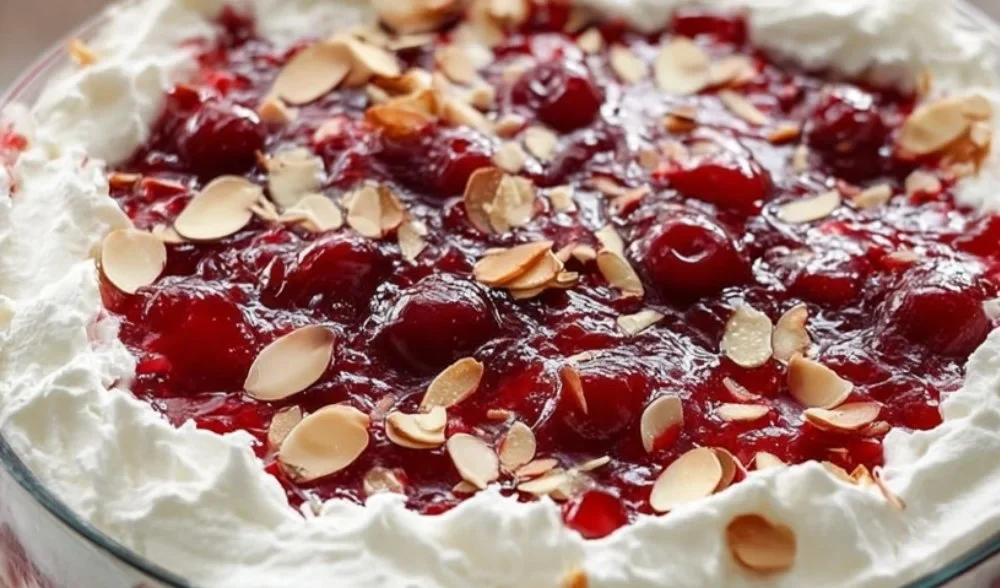
Presentation should communicate the structural contrasts—visible cake cubes, a bright cherry band, a smooth pudding layer, and a cloud of whipped cream.
Maintaining quality after cooking
Holding considerations are straightforward: refrigeration at 35–38°F, covered, will maintain quality for 24–48 hours. After 48 hours the angel food cake will lose its aeration and the layers will homogenize due to osmotic exchange. Minimize condensation by allowing plates to come to service temperature in the cooler briefly before plating.
Avoid freezing; thawing breaks the pudding gelatin network and separates the whipped cream, resulting in textural failure. For events, assemble no more than 12–16 hours before service and keep covered to prevent flavor absorption from the refrigerator.
For questions about ordering or arranging production quantities, consult my professional contact procedures: professional contact.
Questions from home cooks (chef answers)
Q: Can I substitute fresh cherries for the pie filling?
A: Fresh cherries will change hydration and sweetness levels. If using fresh, macerate with sugar and a small amount of lemon juice and reduce the liquid by simmering to a syrupy consistency; however, this deviates from the recipe’s instruction to use canned pie filling.
Q: Will the dessert be soggy if prepared the night before?
A: Yes—overnight refrigeration increases syrup migration. Prepare within a 12–18 hour window for best structural clarity. If you must prepare earlier, use slightly larger cake cubes and assemble the fruit and cream components just prior to service.
Q: Can I stabilize the whipped cream with gelatin?
A: Gelatin will increase stability but alters mouthfeel. If you elect to use gelatin, dissolve a small amount (about 1/2 teaspoon) in cold water, bloom, then warm to liquefy and incorporate sparingly into the whipped cream. This is a technical modification and should be tested before service.
Q: How do I prevent the pudding from becoming grainy?
A: Cook according to package instructions, use medium heat, and stir constantly to avoid localized overheating. Remove from heat as soon as it thickens and cool rapidly over an ice bath to arrest starch gelatinization.
Final chef notes
This preparation is disciplined: do not rush layer assembly, control temperatures, and maintain uniform cube sizing to preserve the intended contrasts. The strength of Heaven on Earth Cake lies in its simplicity—each component serves a clear functional purpose and must be treated precisely to produce the intended layered experience. Taste as you assemble—adjust nothing in proportions, but verify that each component is at the correct temperature and viscosity before it meets the others.
Conclusion
For a canonical reference and visual guide to this exact composition, consult the original recipe notes at Heaven on Earth Cake – The Country Cook.
Heaven on Earth Cake
Ingredients
Method
- Cut the angel food cake into cubes and place half of the cubes in a trifle dish or large bowl.
- Spoon half of the cherry pie filling over the cake cubes.
- Prepare the vanilla pudding according to package instructions and pour half over the cherries.
- In a separate bowl, whip the heavy cream with sugar and vanilla extract until soft peaks form.
- Spread half of the whipped cream over the pudding.
- Repeat the layers with the remaining cake cubes, cherry pie filling, pudding, and whipped cream.
- Refrigerate for at least 2 hours before serving.