Fluffy Japanese Cotton Cheesecake Cupcakes
Introduction
As a chef with a focus on refined technique and precise ingredient control, I regard the Fluffy Japanese Cotton Cheesecake Cupcakes as an exercise in balancing aeration and emulsification. These small-format cheesecakes distill the characteristics of the classic soufflé-like Japanese cotton cheesecake into single-serving units: an ultra-light crumb delivered by a stabilized meringue, a tender dairy matrix from cream cheese and milk, and a restrained sweetness that allows texture and aroma to register first. This recipe rewards rigorous attention to temperature, mixing order, and folding rhythm; each action has a predictable physical consequence that determines the final mouthfeel and oven lift.
The culinary logic behind this dish
The architecture of this recipe is deliberately simple because the technique is the determinant of success. The cream cheese base is an emulsion of fat and water that must be smooth and homogenous to avoid graininess. The meringue is the leavening engine: air trapped in protein-stabilized foam that expands with heat. Combining the two requires a reconciliation of densities and shear sensitivities — too aggressive and the meringue collapses, too timid and the batter will be uneven and flat. Flour and cornstarch are present in a small percentage to lend structure without weighing down the batter; they set during baking to provide a delicate scaffold that maintains aeration after cooling. Salt and vanilla are modest but essential: salt sharpens perceived flavors and improves protein stability in the meringue, while vanilla rounds the dairy notes.
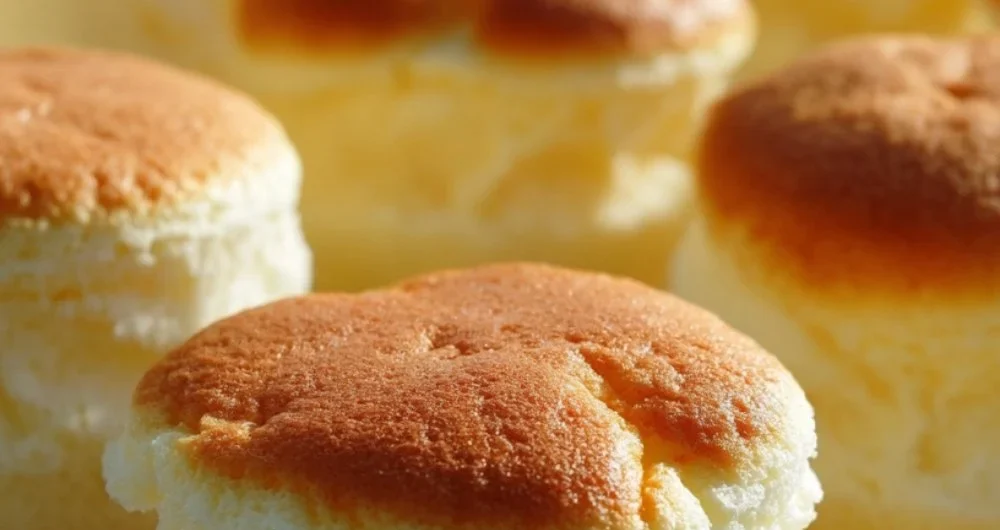
Thermal decisions—baking temperature and time—are informed by the interplay of Maillard development and interior-setting kinetics. A moderate oven (320°F / 160°C) encourages steady expansion of trapped air while allowing proteins and starches to coagulate gradually, producing the characteristic pale gold exterior and custardy interior typical of cotton cheesecake. Cooling in the tin prevents rapid contraction and subsequent cracking; gradual temperature decline preserves the tender crumb.
How to make Fluffy Japanese Cotton Cheesecake Cupcakes
This recipe proceeds in three primary stages: preparing the cream cheese batter, whipping a stabilized meringue, and folding the two together before baking. Each stage has specific tactile and visual cues that indicate readiness.
- Cream cheese batter: Beat the softened cream cheese with sugar until homogeneous and silky. Incorporate milk, egg yolks, and vanilla to form a smooth, emulsified base. Sifting the dry components ensures an even dispersion and avoids lumps that would create textural defects.
- Meringue: Begin with egg whites and salt to build volume; the salt assists in protein uncoiling at low levels and contributes to overall flavor balance. Introduce sugar incrementally to the soft peak stage to produce a glossy, stable meringue capable of withstanding folding.
- Folding and baking: Integrate the meringue in three additions, using a lift-and-fold motion that preserves volume while achieving uniform distribution. Portion into liners and bake at the prescribed temperature until the tops register a pale golden hue and the centers are set. Cool in the tin to stabilize structure before dusting and serving.
Ingredients :
8 oz cream cheese, softened, 1/4 cup granulated sugar, 4 tbsp milk, 3 large eggs, separated, 1 tsp vanilla extract, 1/2 cup all-purpose flour, 1 tsp cornstarch, 1/8 tsp salt, 1/4 cup powdered sugar (for dusting)
Directions :
Preheat the oven to 320°F (160°C). Line a muffin tin with cupcake liners or parchment paper., In a mixing bowl, beat the softened cream cheese with granulated sugar until smooth. Add the milk, egg yolks, and vanilla extract, mixing well to combine., Sift in the all-purpose flour and cornstarch, and mix until there are no lumps., In a separate bowl, beat the egg whites and salt until soft peaks form. Gradually add the granulated sugar (from the egg whites) while continuing to beat until stiff peaks form., Gently fold the whipped egg whites into the cream cheese mixture in three additions, being careful not to deflate the mixture., Divide the batter evenly among the cupcake liners, filling them about 2/3 full., Bake in the preheated oven for 30 minutes, or until the tops are lightly golden and the centers are set., Remove from the oven and let cool completely in the tin., Once cooled, dust the tops with powdered sugar and serve.
Ingredient analysis through a chef’s lens
- Cream cheese (8 oz, softened): The choice of cream cheese and its temperature are foundational. Cold cream cheese resists incorporation and will produce lumps; too warm and the emulsion can separate into an oily phase. Target a texture that is cool but pliable—softened enough to blend easily but not fluid.
- Granulated sugar (1/4 cup): Sugar performs multiple functions: sweetener, stabilizer for the meringue, and moisture retainer. The distribution of sugar between the base and the meringue influences surface browning and foam stability.
- Milk (4 tbsp): Milk adjusts viscosity and contributes lacteal aroma. It also moderates the batter temperature, which can be important when combining with whipped egg whites.
- Eggs, separated (3 large): Yolks enrich and emulsify the batter; whites create the aerated structure. Proper separation technique is essential — even trace yolk in the whites will inhibit foam formation.
- Vanilla extract (1 tsp): A small, focused amount offers aromatic lift without dominating.
- All-purpose flour (1/2 cup) and cornstarch (1 tsp): The flour provides primary gluten-based structure, while cornstarch lightens the crumb by diluting gluten and improving tenderness.
- Salt (1/8 tsp): Small but critical for amplifying flavor and improving meringue stability.
- Powdered sugar (for dusting): A finishing element to create visual contrast and a light sweetness on the surface.
Kitchen workflow & technique breakdown
An efficient workflow reduces heat and time loss between stages, which is significant when working with temperature-sensitive components such as meringue.
- Preparation: Preheat the oven to 320°F (160°C) and line the tin. Weigh and measure ingredients in advance — mise en place reduces pauses that allow the cream cheese to over-warm or the meringue to deflate.
- Cream cheese base: Use a paddle attachment or a flexible spatula; beat just until smooth. Overbeating can incorporate excess air into the dairy base, making it more susceptible to collapse when combined with meringue.
- Dry ingredients: Sift flour and cornstarch directly into the cream cheese mixture to avoid clumps. This step also reduces the need for vigorous mixing.
- Meringue: Use a cold, clean bowl and room-temperature whites. Start at moderate speed to create consistent foam, then increase speed for volume. Add sugar gradually to ensure dissolution and a glossy finish.
- Folding: Use three additions of meringue. The first addition is mixed more aggressively to lighten the base; subsequent additions require increasingly gentle folding to maintain aeration. Use a wide rubber spatula and a lift-and-fold motion along the bowl wall.
- Portioning and baking: Fill liners uniformly to ensure even baking. Rotate the pan once midway through if your oven has hot spots, but avoid excessive jar that will deflate the batter.
Texture control, heat management & timing
Texture is the product of controlled aeration and judicious heat application. Aim for a batter that is airy yet cohesive; when scooped, it should mound slightly but flow slowly. Oven temperature at 320°F (160°C) provides a balance: sufficient heat to set proteins without rapid crust formation that would trap moisture and cause surface cracking. Baking time (30 minutes) is calibrated for small molds; indicators of doneness include a pale golden crown and a center that yields only slightly when nudged — it should not be liquid.
Equally important is cooling. Rapid cooling causes differential contraction between exterior and interior, which yields fissures and a drier texture. Cooling in the tin allows residual steam to dissipate slowly, preserving the custardy core. If you need to speed cooling, do so after an initial rest in the tin rather than immediately removing from the mold.
Professional variations
Within the constraint of the original formula, professional techniques can be applied to accentuate specific attributes without altering ingredient lists or quantities:
- Oven environment: Introducing ambient humidity (e.g., a shallow pan of water elsewhere in the oven) can moderate crust formation and encourage even expansion. This is a technique used in some professional chiffon or sponge bakes to preserve a soft exterior.
- Equipment: Using a convection oven reduces bake time and encourages even coloring but may require a temperature adjustment; when using convection, reduce time monitoringly rather than changing recipe temperatures outright.
- Presentation: Bake in slightly larger or smaller molds for textural variation, but be mindful that surface-to-volume ratio affects set time. Adjust bake time accordingly while using the same visual cues for doneness.
- Stabilization: For more resilient cupcakes intended for transport, an additional brief rest under light refrigeration before unmolding helps the interior set further without changing the recipe.
These approaches refine technique rather than modify the recipe itself.
Finishing touches & plating philosophy
The finished cupcake should be restrained in presentation to emphasize texture and subtle flavor. A light dusting of powdered sugar provides visual contrast and a delicate sweetness that complements the dairy tang. For plating, choose a simple white or neutral plate to accentuate the pale golden tops and the soft shadowing of the crumbs. Avoid heavy sauces or garnishes that eclipse the delicate structure; if pairing is desired, a tiny quenelle of unsweetened crème fraîche or a spoonful of concentrated fruit reduction on the side can provide acidity and mouth-cleansing contrast without submerging the primary texture.
When assembling for service, consider thermal contrast: slightly chilled centers reveal a creamier mouthfeel, while room-temperature examples highlight airy lift. Serve within a few hours of preparation for optimal height and aeration.
Maintaining quality after cooking
Storage choices determine how the delicate crumb ages. Cotton-style cheesecakes are more perishable than dense cheesecakes due to their higher air content and lower sugar concentration. Refrigeration is necessary for food safety and to preserve texture; however, prolonged refrigeration can collapse aeration and dry the surface. Store in an airtight container for up to 48 hours. For short-term retention of height and texture, place a sheet of parchment between cupcakes in stacked containers to prevent condensation contact. Re-equilibrate to room temperature for 15–30 minutes before serving to restore aroma and soften the crumb.
If shipping or transporting, a brief chill to firm the structure followed by careful packing with immobilization prevents jostling that will deflate the meringue-stabilized interior.
Questions from home cooks (chef answers)
Q: My cream cheese lumps when I mix it. How do I prevent or fix that?
A: Ensure the cream cheese is softened uniformly but not overheated. Beat at medium speed until smooth; if lumps remain, pass the mixture through a fine mesh sieve or use a warm spatula to press them out, then briefly re-whip to reincorporate.
Q: The egg whites deflate when I fold them in. What went wrong?
A: Likely factors include residual fat in the whipping bowl, overmixing the initial base which made it too dense, or using an incorrect folding technique. Use a wide spatula and fold in stages: the first addition lightens the base and can be beaten a touch more vigorously to integrate; subsequent additions should be folded gently with minimal downward strokes.
Q: The cupcakes crack on top — is that a problem?
A: Minor cracking is primarily cosmetic and indicates rapid surface setting. It often results from hot spots or an oven that runs hot. Aim for even oven temperature and gradual cooling. Slight cracks do not necessarily impact texture significantly.
Q: Can I make the batter ahead?
A: Meringue loses volume if held. For best results, prepare the cream cheese base ahead, but whip the egg whites and fold immediately prior to baking.
Final chef notes
The Fluffy Japanese Cotton Cheesecake Cupcakes are an exercise in restraint and control. Success is not defined by dramatic ingredients but by disciplined execution: temperature control, careful aeration, and respectful folding produce the ethereal texture that distinguishes this style. Focus on tangible cues — gloss and peak stiffness of the meringue, the sheen of the cream cheese base, the pale golden color of the tops — rather than timing alone. Precision in these elements yields a product that is delicate in the mouth but robust in its subtle flavor profile.
Conclusion
For additional technical reference and a visual companion focused on the miniaturized Japanese cotton cheesecake format, see Mini Japanese Cotton Cheesecake – INDY ASSA.
Fluffy Japanese Cotton Cheesecake Cupcakes
Ingredients
Method
- Preheat the oven to 320°F (160°C) and line a muffin tin with cupcake liners or parchment paper.
- In a mixing bowl, beat the softened cream cheese with granulated sugar until smooth.
- Add the milk, egg yolks, and vanilla extract, mixing well to combine.
- Sift in the all-purpose flour and cornstarch, and mix until there are no lumps.
- In a separate bowl, beat the egg whites and salt until soft peaks form.
- Gradually add the granulated sugar while continuing to beat until stiff peaks form.
- Gently fold the whipped egg whites into the cream cheese mixture in three additions, being careful not to deflate the mixture.
- Divide the batter evenly among the cupcake liners, filling them about 2/3 full.
- Bake in the preheated oven for 30 minutes, or until the tops are lightly golden and the centers are set.
- Remove from the oven and let cool completely in the tin.
- Once cooled, dust the tops with powdered sugar and serve.