Easy Chocolate Raspberry Tart
Introduction
This recipe for Easy Chocolate Raspberry Tart presents a disciplined interplay between a dense chocolate ganache and the bright, acid-fruit clarity of fresh raspberries. The tart is built from three principal considerations: a compact Oreo crumb crust that provides structure and contrast; a bittersweet chocolate filling that demands careful heat control to develop smoothness and shine; and a topping of raw raspberries that introduces volatile aromatics and a piercing acidity. Each element contributes to the finished mouthfeel and balance, and each requires precise technique to reach its potential.
For cooks seeking streamlined yet refined desserts, this recipe sits alongside other reliable repertoire for weeknight dinner menus and focused dinner-party service. If you compile a menu that features uncomplicated, high-impact desserts you may find helpful references among curated collections like this selection of easy dinner recipes.
The culinary logic behind this dish
The rationale driving this tart is contrast. A crumb crust made from Oreo cookies creates a subtly bitter, cocoa-laced matrix that resists becoming soggy when met with a dense ganache because the crumbs are compacted and the fat content is stabilized with melted butter. The ganache itself is essentially an emulsion: heavy cream provides water, milk fats and emulsifiers; bittersweet chocolate supplies cocoa solids, cocoa butter and additional emulsifiers. Proper technique converts these components into a homogenous, glossy modal mass rather than a broken, grainy pool. The raspberries add freshness, acidity and a textural counterpoint: their seeds and tender flesh punctuate the smooth ganache. The confectioners’ sugar dusting finishes the composition visually and offers a transient sweetness on the palate.
This dish operates on thermal transitions: warm ganache that sets as it cools, the crust firming when chilled, and berries that remain raw to retain aroma. Understanding these transitions is the key to controlling texture and flavor intensity.
How to make Easy Chocolate Raspberry Tart
The procedure is intentionally concise: assemble the crust, prepare a ganache, pour and set, finish with raspberries and dusting. Technique matters at each transfer point. When melting butter into Oreo crumbs, distribute heat evenly and compact the mixture uniformly—this prevents weak zones and localized sogginess. When warming cream, bring it to a scald but not a boil so that the heat is sufficient to melt the chocolate without creating excess steam that can separate the emulsion. When combining cream and chocolate, temper by pouring over chocolate and letting it rest for 60–90 seconds before stirring from the center outward to encourage a controlled emulsion. Scrape and strain if needed for absolute smoothness. Chill the tart sufficiently to allow the ganache to crystallize and the crust to firm; insufficient chilling results in a soft perimeter that reduces clean slicing and alters mouthfeel.
Refer to organized technique resources when planning multiple dishes; for example, consult collections of quick, easy recipes for workflow ideas that integrate a dessert like this into a broader service.
Ingredients :
1 ½ cups Oreo crumbs (about 24 cookies), 6 Tablespoons (85 g) butter (melted), 1 ¼ cups (300 ml) heavy cream, 2 cups (12 oz) good-quality bittersweet chocolate (chopped into similar size pieces), 1 teaspoon pure vanilla extract, 2 pints (about 4 cups) fresh raspberries, Confectioners’ sugar for dusting
Directions :
Crust, Filling
Ingredient analysis through a chef’s lens
Oreo crumbs function as both structure and flavor base. Compared to a traditional sable or pâte sucrée, cookie crumbs have less gluten and more cocoa and sugar; they bind and set via melted butter rather than gluten development. The butter amount here is calibrated to coat the crumbs and render them pliable for pressing into a pan. Too little butter produces a friable crust; too much yields a greasy, overly dense base.
Heavy cream is the liquid phase for the ganache. Its fat percentage is crucial: cream under 30% fat risks a thinner finished ganache and can accentuate bitterness; double or whipping cream in the 35–40% range delivers a stable emulsion and a satiny mouthfeel. Bittersweet chocolate should be of reliable provenance and evenly chopped; uniform pieces melt predictably and prevent localized overheating. Vanilla extract is minimal but intentional—used to round flavor and soften the intensity of dark chocolate. Fresh raspberries are high in citric acid and volatile aromatics; select ripe, intact berries that are firm enough to hold shape yet fragrant. Confectioners’ sugar is solely decorative and should be applied sparingly to avoid dulling the direct raspberry aroma.
Cross-references to technique can be practical; a well-structured dessert program often draws on modular recipes found in collections of easy dinner recipes and quick, easy recipes to coordinate timing and ingredient usage.
Kitchen workflow & technique breakdown
Workflow begins with mise en place. Chop chocolate into consistent pieces and place in a bowl. Measure cream and vanilla precisely. Prepare a tart pan or loose-bottom ring and have a baking sheet ready for chilling. The crust step is rapid: combine Oreo crumbs with melted butter, mix until uniformly moistened, and press into the pan with firm, even pressure. A flat-bottomed measuring cup or glass works well to compact the crumbs into a dense, even layer—this mechanical compression is what mimics the structural integrity of a baked crust.
While the crust chills, heat the cream to a scald—tiny bubbles forming at the edges but not a boil. Pour the scalded cream directly over the chopped chocolate and let it sit; this rest period allows thermal conduction to soften the chocolate evenly. Begin stirring gently from the center outward in concentric motions; this prevents air incorporation and ensures the fat and aqueous phases coalesce. Finish with the vanilla and, if necessary, a short pass with an immersion blender set on low to eliminate streaks—use with restraint to avoid emulsifying too much air.
Pour the ganache into the chilled crust; the temperature differential accelerates setting and reduces seepage into the crumb base. A shallow set at room temperature followed by refrigeration gives the ganache a glossy, dense finish. Time your chilling based on the size and metal or ceramic composition of your pan: metal chills faster; ceramic holds heat longer.
Texture control, heat management & timing
Texture is a function of fat crystallization and water dispersion. Allow ganache to cool undisturbed until it reaches a consistency that yields clean cuts; this typically requires at least two hours in refrigeration for the quantity specified, longer if your refrigerator door is frequently opened. Avoid freezing—rapid cooling produces contraction and potential cracking. If the ganache appears dull or seedy, gentle warming over a bain-marie followed by careful re-emulsification can restore sheen, provided no water has contaminated the chocolate.
Heat management is most critical during chocolate melting and cream heating. Overheat chocolate and you risk scorching—the aroma will turn acrid and the texture grainy. Boiling the cream introduces excess steam that can cause the ganache to separate. The window between scald and boil is small; watch closely to maintain a controlled scald. Timing in plating matters: assemble the raspberries just prior to service to preserve their aromatic intensity and prevent bleed into the ganache which can pigment the surface.
Professional variations
Within professional pastry parameters you can modify mouthfeel and flavor without altering fundamental quantities. For more viscosity and a less-set ganache, substitute a portion of the heavy cream with single cream, but be mindful that overall stability decreases. For added depth, infuse the cream with citrus peel or whole spices at scald temperature and strain before pouring over chocolate; do this judiciously so as not to overpower the raspberry partner. For a firmer set, add a small quantity of couverture with higher cocoa butter content. None of these changes require altering the recipe’s listed measurements—tweaks should occur in technique rather than in wholesale substitution.
Savour a restrained salt accent: a light flake salt added to the surface just prior to serving lifts flavors without disrupting emulsion. For service-focused variations, consider single-serve rings or tartlets; scale time and chilling accordingly.
Finishing touches & plating philosophy
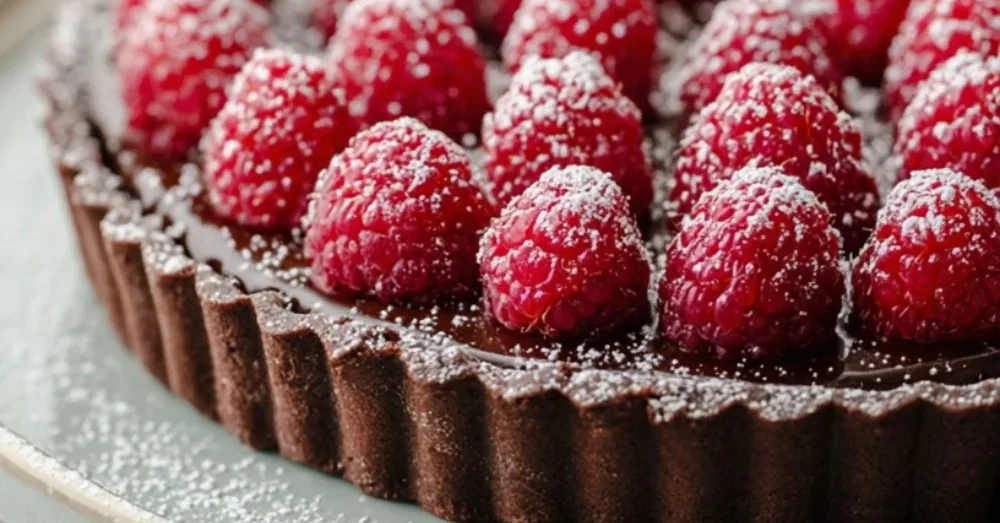
Present this tart with an emphasis on contrast and restraint. The raspberries should be arranged to expose interior flesh and seeds, allowing their aroma to be delivered to the nose on approach. A light dusting of confectioners’ sugar adds visual contrast and a slight textural variance without contributing significant sweetness. When cutting slices, use a hot, dry knife and wipe it between cuts to preserve clean edges and avoid dragging ganache.
Plate composition can rely on a smear of reduced raspberry coulis or a small quenelle of lightly whipped cream to introduce an airier texture, but avoid over-decoration; the dish’s power is its simple, primary elements. For larger service, mark portions in the refrigerator with a thin score to guide slicing and ensure uniformity under pressure.
Maintaining quality after cooking
This tart keeps best refrigerated, covered, and consumed within 48 hours when freshness of raspberries is critical. Covering prevents flavor transfer and slows moisture loss, but allow slices to return to a slightly warmer temperature (15–20°C) for twenty minutes before service to maximize aroma release and soften bite. Do not freeze with fresh raspberries in place; freezing ruptures berry cells and produces a weepy texture upon thawing. If preparing in advance, assemble up to the point of raspberry placement and store chilled; add raspberries immediately before service.
For batch service, consider sourcing raspberries closest to service time and store them in a single layer on a paper towel-lined tray to reduce condensation and preserve shape.
Questions from home cooks (chef answers)
Q: Why use Oreo crumbs rather than a traditional baked crust?
A: Oreo crumbs provide immediate cocoa flavor and eliminate the need to blind-bake a dough; when combined with melted butter and compacted, they form a stable matrix that holds ganache weight while offering a crisp, slightly gritty contrast.
Q: My ganache seized—how can I rescue it?
A: If the ganache becomes grainy, warm it gently over a double boiler and whisk slowly to re-emulsify. If water contamination caused seizing, add a small portion of warmed heavy cream and whisk to restore a cohesive emulsion.
Q: How can I keep raspberries from bleeding onto the ganache?
A: Place raspberries just prior to service. If you must assemble in advance, lay a thin layer of tempered chocolate atop the ganache and allow it to set; place raspberries on this shell to create a moisture barrier.
Q: Can I use frozen raspberries?
A: Frozen raspberries release juice and lose structure when thawed. Use them only if you plan to macerate into a sauce rather than as fresh garnish.
Final chef notes
This tart rewards disciplined technique more than complex ingredients. Control of temperature and timing—especially during ganache preparation and chilling—determines the finished texture and presentation. Use quality bittersweet chocolate and fresh raspberries; the recipe’s simplicity exposes the components, so provenance matters. When serving, prioritize contrast: a clean cut, a bright berry, and a restrained dusting will communicate the dessert’s intent. For those compiling a concise repertoire, this tart complements menus where preparation time must be efficient yet the result must read as refined.
Conclusion
For further reading and variant inspiration, consult this detailed take on a darker rendition at Dark Chocolate Raspberry Tart, a homestyle adaptation at Easy Chocolate Raspberry Tart – If You Give a Blonde a Kitchen, and another pastry-driven interpretation at Chocolate Raspberry Tart | Buttermilk by Sam.